I’m not a great lover of Muesli, not the least because it gives me terrible indigestion afterwards.
I don’t know why.
Porridge is the same, must be the Oats?
Now I know the benefits of eating a high fibre diet and the value of seeds and nuts but muesli is just an overdose of good stuff and you know what they say about ‘ too much of a good thing’?
The current Mrs ND tends to eat this stuff and thinks if she buys it in Waitrose or M&S it’s going to be better for her. The assumption being that price is best.
But this survey proves otherwise.
Interestingly the top one also works out the cheapest per Kilo.
I was in Tesco with my mate Ram this week and he was looking for a healthy drink. He wanted some thing low in sugar.
I suggested Kafir which I really like and I introduced him to the Yuka App which I use all the time.
His preferred choice of Kafir with Mango came in at 5.5G of sugar ( per 100 ml) mainly due to the Mango.
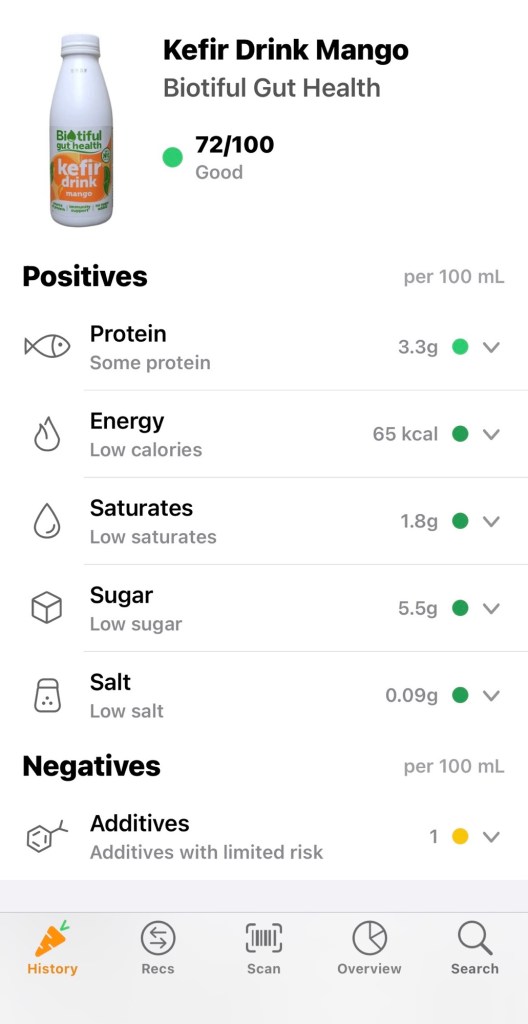
Whilst my other favourite, Tescos own apple juice was much higher at 11.2 g. Per 100ml.
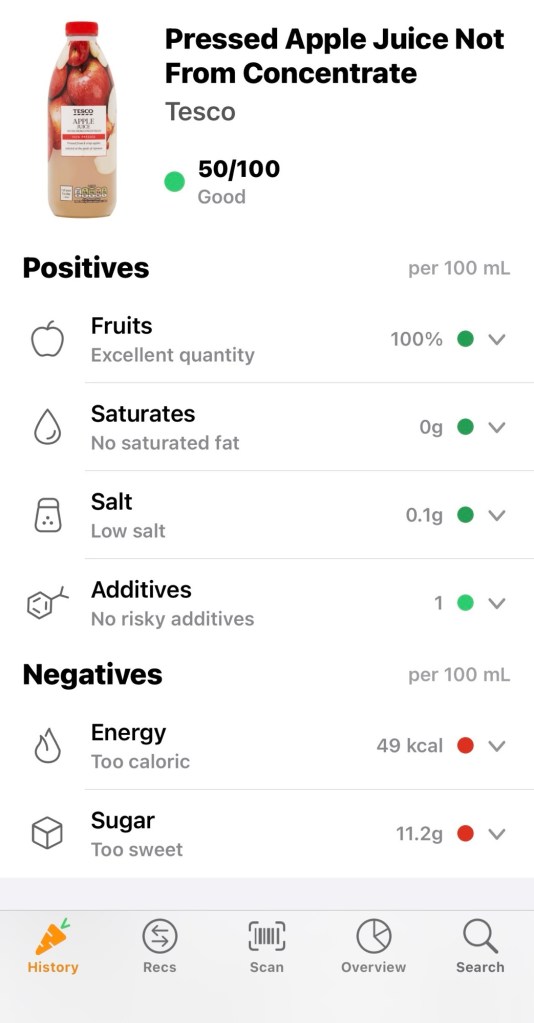
So there is a trade off .
I tend to drink the Apple juice with Apple cider vinegar added but I don’t drink a lot of it and it’s in stead of.
What I mean by that is:-
What would I have drunk if I hadn’t had a glass of Apple juice.
In the past it would have been a pint of Cider, or a glass of wine.
Now I don’t drink alcohol so I substitute apple juice which must be a better option?
Which magazine ( probably my most trusted tool) say they used the following methodology to measure their results:
NPM scores are calculated by taking into account both positive/beneficial ingredients such as fibre and protein, and less beneficial ones including sugar and saturated fat. It also factors in FVN – fruit, vegetable and nut – content.
Once we had these figures, an official NPM tool calculated a final raw score indicating either a ‘pass’ or ‘fail’ for HFSS purposes, which we were then able to turn into a scoring system from 0 (least healthy) to 100 (most healthy).
On a scale of 1 to 100, a ‘pass’ (denoting ‘healthy’) is anything from 63 to 100, and the higher the score, the healthier the food. Anything 62 or less is a ‘fail’. It is worth noting that a newer version of the model, NPM 2018, has been officially published by the UK government and will introduce changes, such as stricter thresholds for energy density and fat.
However, it’s likely to take some time before it is applied.
They seem to have measured “The Healthiest” muesli, which is fine but I can’t see they have actually addressed Taste (unless I’ve missed that somewhere)?
So it’s a bit like saying which is the best antibiotic. It might do you good but it will taste shite?
And taste is really the driving factor when it comes to healthy eating.
If you can find something that is good for you and you enjoy eating it, you’re quids in.
NPM scores are calculated by taking into account both positive/beneficial ingredients such as fibre and protein, and less beneficial ones including sugar and saturated fat. It also factors in FVN – fruit, vegetable and nut – content.
Once we had these figures, an official NPM tool calculated a final raw score indicating either a ‘pass’ or ‘fail’ for HFSS purposes, which we were then able to turn into a scoring system from 0 (least healthy) to 100 (most healthy).
On a scale of 1 to 100, a ‘pass’ (denoting ‘healthy’) is anything from 63 to 100, and the higher the score, the healthier the food. Anything 62 or less is a ‘fail’. It is worth noting that a newer version of the model, NPM 2018, has been officially published by the UK government and will introduce changes, such as stricter thresholds for energy density and fat.
However, it’s likely to take some time before it is applied.
Our use of the 2004 NPM aligns with the UK’s regulatory standard. It is a mathematical assessment of nutrient balance per 100g, which ensures a transparent level playing field for objective, category-wide comparison.
So have a look at the article and if you like Muesli, you might want to try one of these but it is a mine field and you need to do your homework. As there are hundreds of options out there.
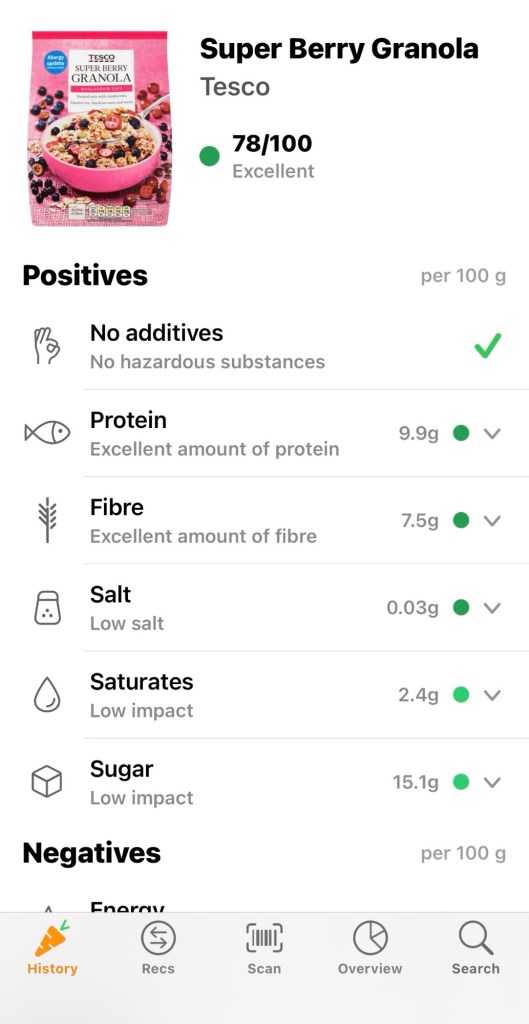
Which ever way it goes, I won’t be taking the Fat boys out for a nice bowl of muesli any time soon.
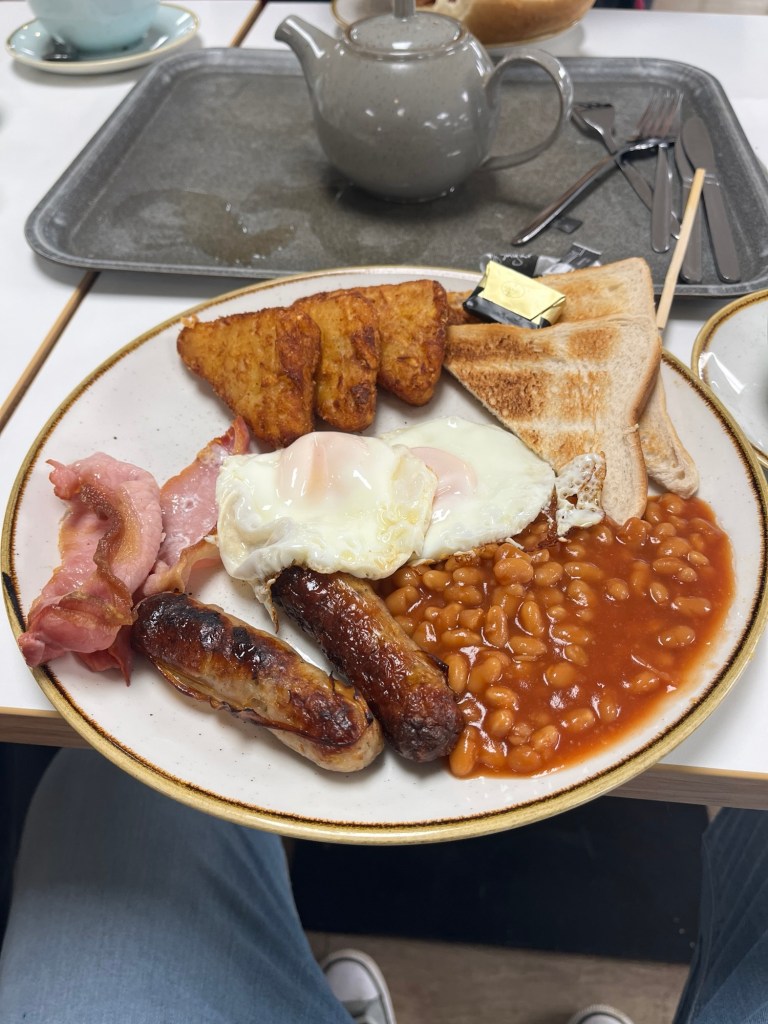
Not when you can get this Full English in the Cafe at Tesco for £9.50.

