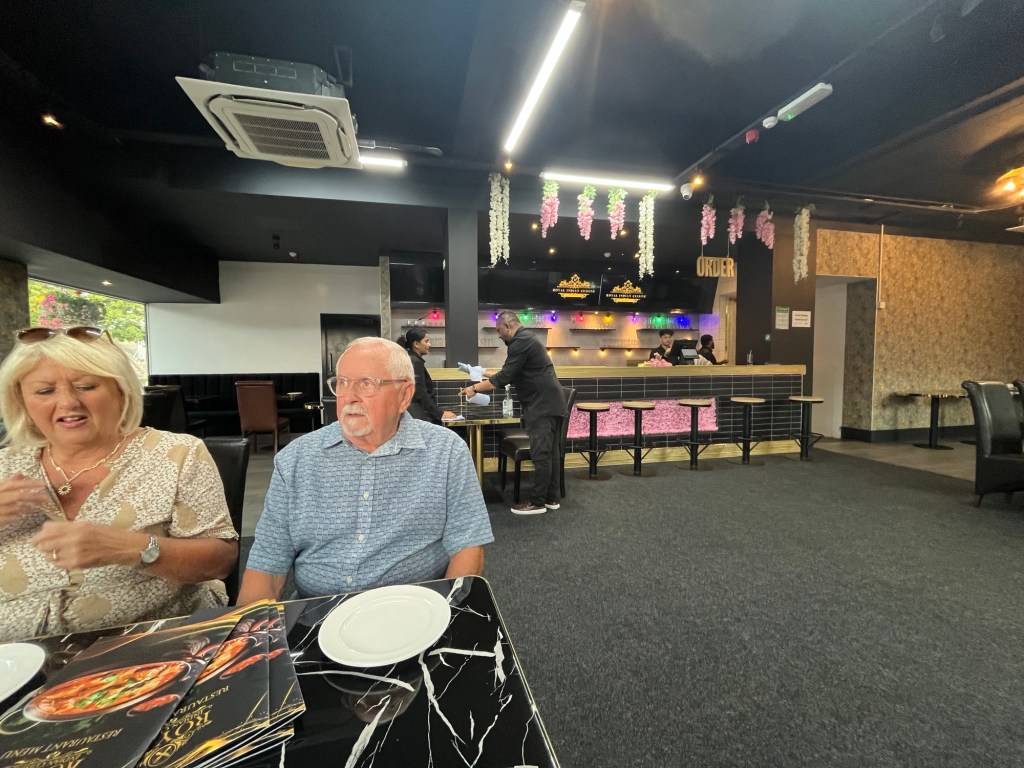
We heard there was a new Indian restaurant opened in Yate, where the old fried chicken take-away had been, so I suggested we give it a try.
After another week of looking after the Grand Kids, Steve and Kathy were happy to go along with that so I booked a table on line, which worked fine.
There was some confusion about whether this was a BYO as there was no mention of it, at least nothing obvious, on their web site. So I sent them an e mail asking the question.
They came back and confirmed it was BYO.
But then I wondered if they charged corkage. (Remember when we went to Jeans Bistroand they charged every person corkage. It cost nearly as much as the meal).
They emailed back and confirmed there was no corkage charge, which was good news.
As most of us are now officially ‘Pensioners’ we have bus passes and the bus into Yate stops just around the corner from Steve’s house (Church Rd) and it’s only a short journey. So Kathy suggested we meet at their house and as it was a lovely evening, we sat outside and had a drink in the evening sun.
One of the other advantages of catching the bus is the frequency and timing. You can down load an app that tells you where the bus is and when it’s due at your stop, so none of that hanging around on a bus stop for hours waiting for a bus that doesn’t turn up!
The bus stop we needed was right opposite the Fire Station in Yate, some where I have fond memories of.
It was what we called back in the day “Day Manning” in that it had a full time crew during the day but was crewed on a retained basis at night when the full timer’s became retined fire fighters responding from home.
It was a bit of a complex system but it worked well for years and gave Yate a peculiar dynamic as all the ‘full time’ guys lived next door to each other in Brigade houses, so there were obviously some personal issues that spilt over into their professional lives. Their kids played together, their wives socialised together and the Firefighters, drank together.
Not always a good combination.
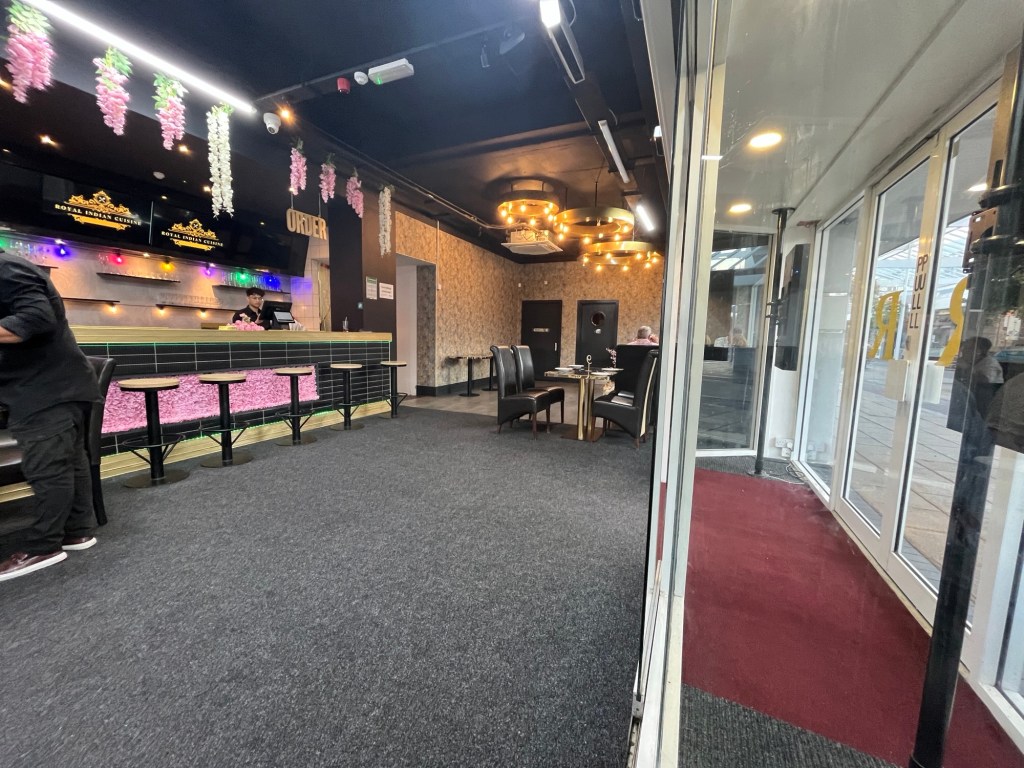
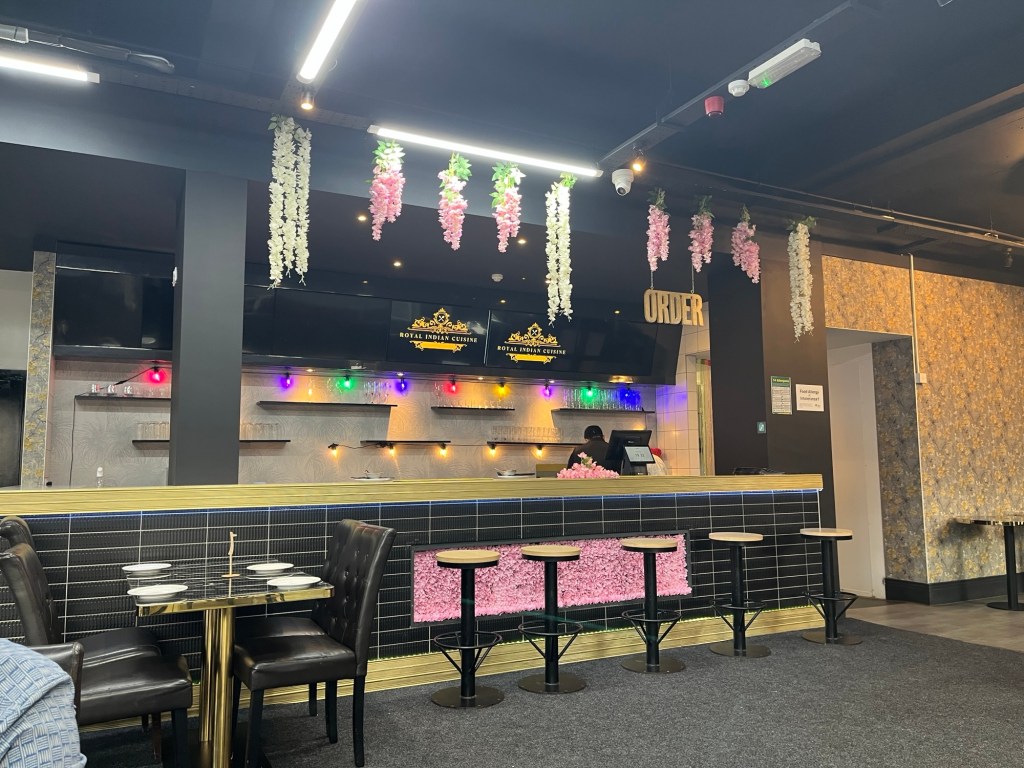
The restaurant looked very modern from outside with lots of glass which was a relic from its previous life as a fried chicken fast food.
It had more of a ‘Nando’s’ feel to it rather than a traditional Indian, but there are plenty of good Indian restaurants around these days that have broken the mold, often with a ‘Fusion’ Menu.
As we entered, one of the staff approached and welcomed us with a hand shake, which was a nice touch.
I told him we had a table booked and he checked my name on a piece of paper ( rather than on line) and once confirmed, showed us to a reserved table.
Unfortunately the table they gave us was just inside the door and below the Air Conditioning vent so I immediately regretted wearing a summer shirt. It was very draughty to the point of being cold.
Jaki immediately asked if we could be moved as she just cant tolerate Air Con, it makes her eyes run and washes away her make up as well as making her grumpy.
The guys were happy for us to take another free table which was in a much better position and was luckily free, though had they been fully booked I don’t know how we would have resolved the issue?
The tables seem to be positioned around the outside of the restaurant, following the windows so there is a lot of empty space in the middle, which they could easily fill with additional tables if there is sufficient demand.
However, it had the effect of making the place feel too big and empty. It was vacuous and the sounds echoed in a ‘tinny’ way which made it hard to hear once everyone was talking. It definitely needed some softening, something to deaden the sound.
Menu’s were delivered and as with all new restaurants, there is a knack to understanding just how the menu works. Its like tackling a puzzle, you have to understand how each menu is put together and, the bigger the menu, the more complex the puzzle.
There was no indication on the menu about how hot each dish was so it was pure guess work. I like the use of a few red Chillies to indicate how hot a dish is.
One of the good things about this venue is their web site which had a very detailed and easily read section detailing their Menu, so Steve and I had spent some time looking at the options before we left home.
They have a section at the front called catagories, not a very ‘Foodie’ title but it worked.
Then if you click on each section, it open’s a bigger page with a detailed description of each option.
I was immediately struck by the number of Fish options available, some thing we have been making at home recently.
In the past, I have avoided Fish Curries because I was concerned about the freshness of the fish. Unless you live in Goa then access to fish is limited, even on an Island like the UK, so I suspect fish is always frozen, not fresh.
That in itself isn’t an issue but the more unscrupulous restaurants may well buy cheap frozen fish in bulk and that isn’t always gonna mean quality.
The other issue is the ‘type’ of fish.
We know from cooking at home that the fish needs to be firm or it will fall apart.
Cod and Haddock are apparently good (if you believe Google Ai) which also suggested Snapper, very American) but we like Monkfish if its available. Any fish that wont fall apart is OK but, here’s the thing.
I don’t like the smell of cooking fish which is why we eat more Fish when we are in Spain where I can cook it outdoors, then the smell isn’t so bad.
Old Fish tends to smell more than fresh fish and a fish Curry that smells of fish ( I know) is horrible. It suggest to me that the fish wasn’t fresh and that puts me off.
So, I wasn’t brave enough to try a Fish Curry on this occasion but I might be tempted in the future.
There was quite a delay in ordering as we needed to read the menu quite carefully before deciding but the staff were perfectly happy for us to take all the time we needed.
Jaki in particular was having a problem.
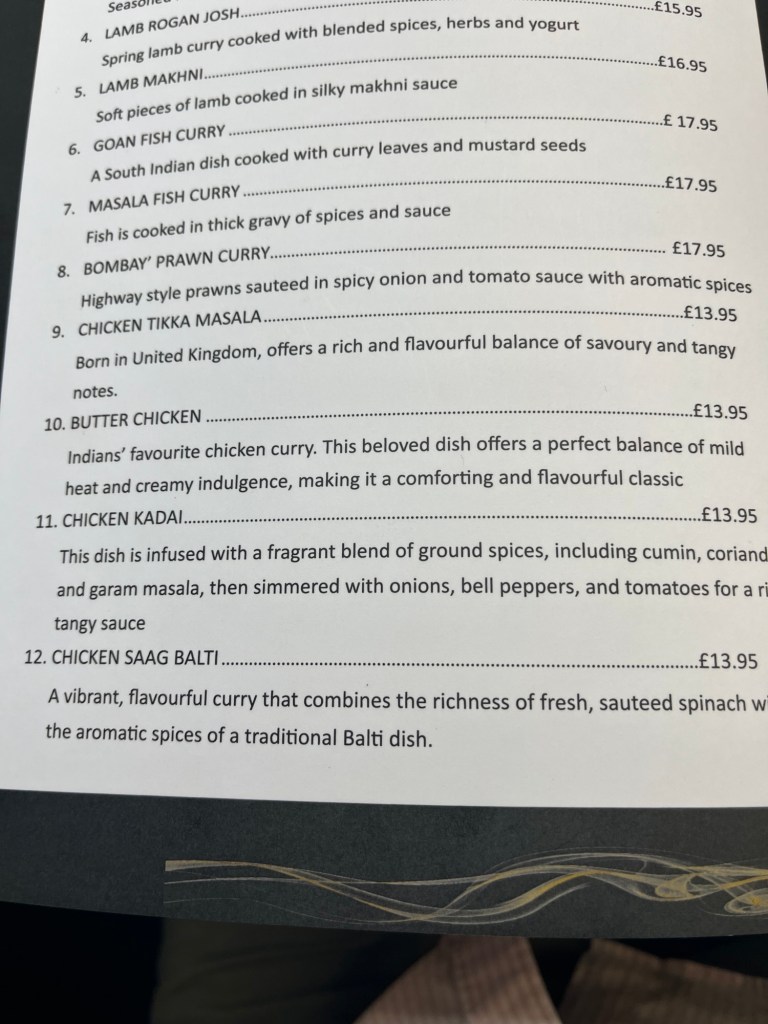
Lately she has taken to having Bombay Potato from the extras menu with her Curry rather than Rice but on this menu the Bombay Potato was a Main meal at £12.95 a pop so it wasn’t an option to have it as a side dish.
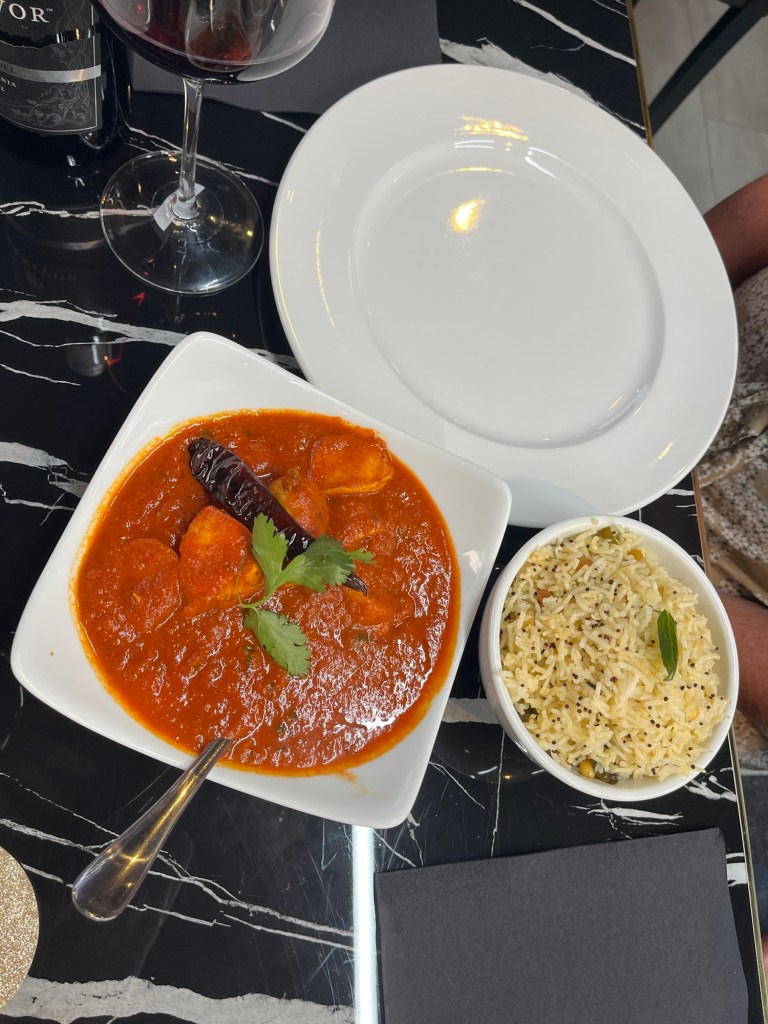
Eventually she settled for Lemon Rice £5.50 though personally I don’t see the point in ‘flavoured rice’ if its then covered in a hot spicy curry sauce, but hey, what do I know about food?
Eventually we had all decided, so our order was taken.
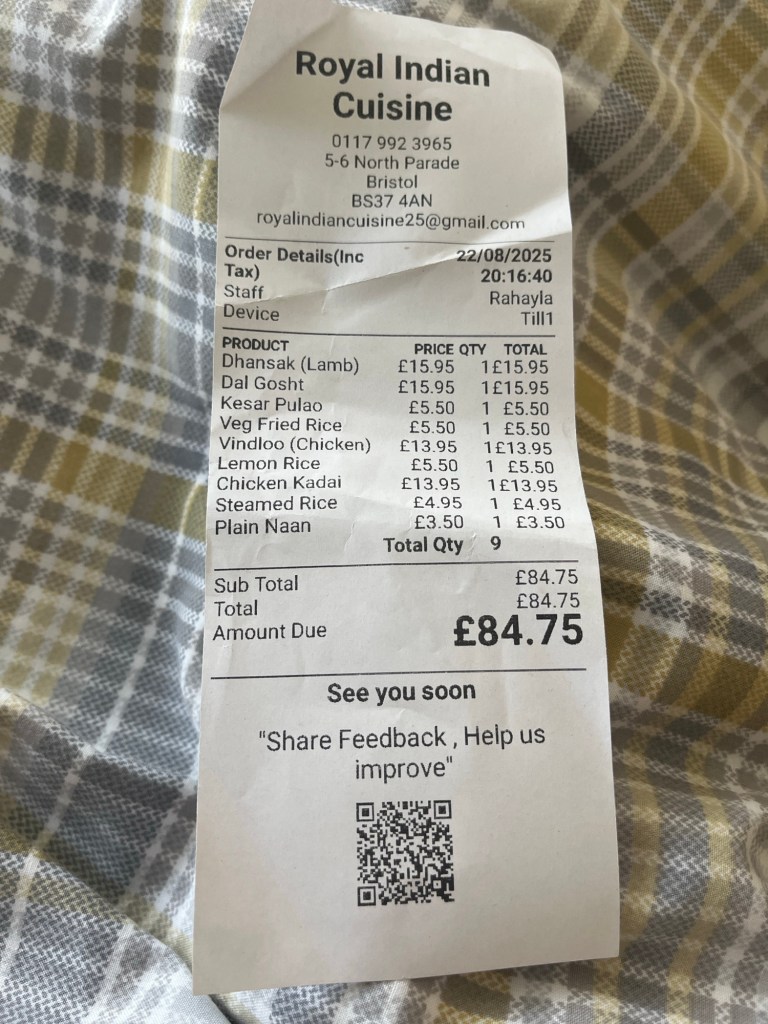
Lamb Dhansak £15.95
Dal Goshi £15.95
Chicken Vindaloo £13.95
Chicken Kadai £13.95
Steve and Kathy shared a Vegetable Fried Rice £5.50 whilst I settled for steamed rice at £4.95.
One of the staff offered to take some pictures for us and we set about drinking our wine whilst catching up on family gossip, which these days tends to centre around Kids & Grand kids, Illness and Pensions.
We tend to stay away from Politics as we aren’t all in the same camp so current affairs can be a thorny subject as well as being totally depressing.
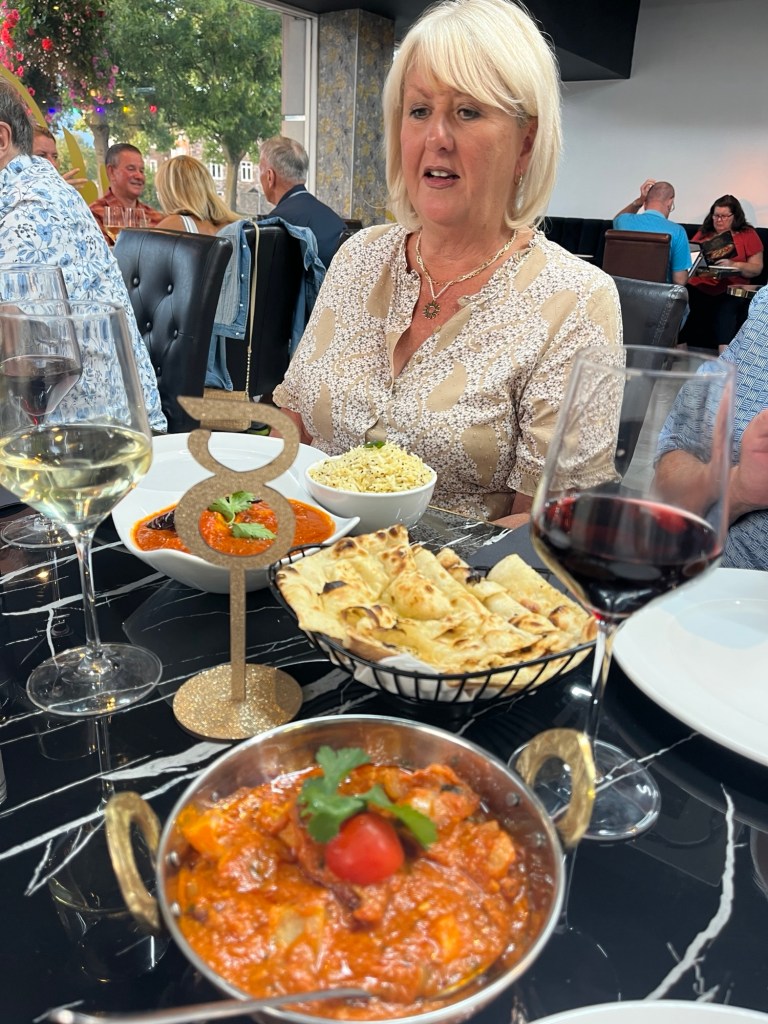
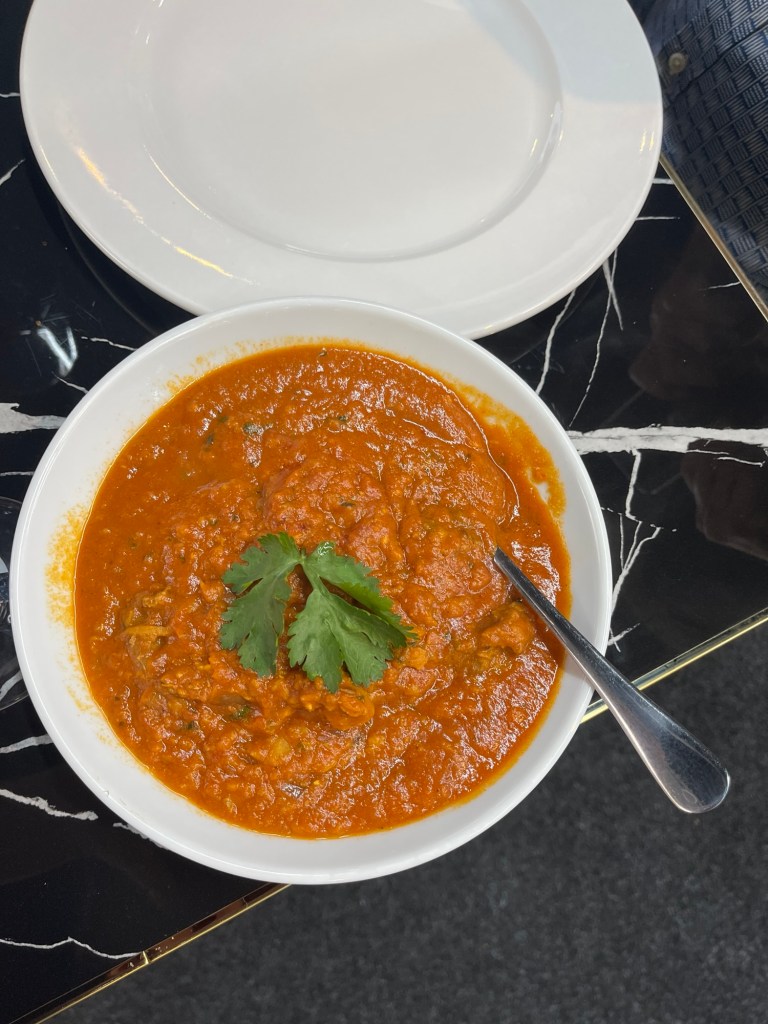
When the food came, it looked good though It was a bit beige.
It wasn’t very flamboyant and lacked a bit of drama.
It reminded me of those Curries they serve in Indian Restaurant’s in Spain where none of the ingredients are really suited to being in a curry but its the best you can get locally.
( I had one recently that had huge pieces of Carrot in it)?
Each dish looked fine though I do miss those warmers they used to supply with a ‘T’ light in the bottom, that kept your curry piping hot.
Mine got cold quite quickly. I guess that was the effect of the air con?
Sadly we couldn’t get stuck in as they forgot to bring the cutlery but once that was available we were keen to sample our choices.
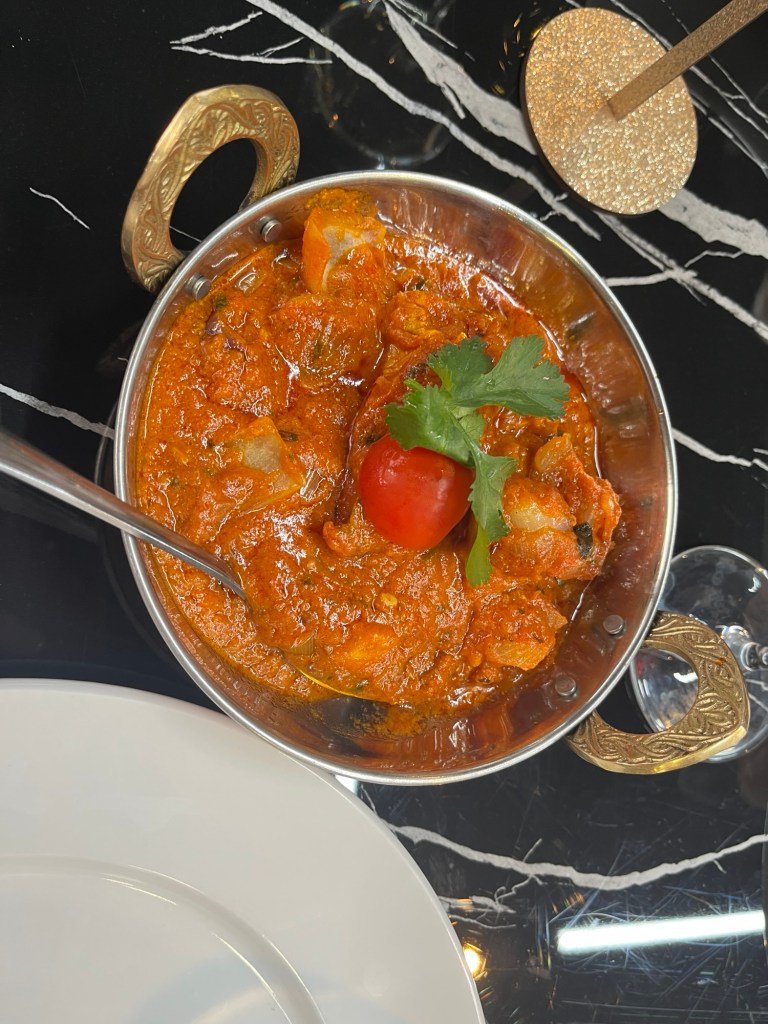
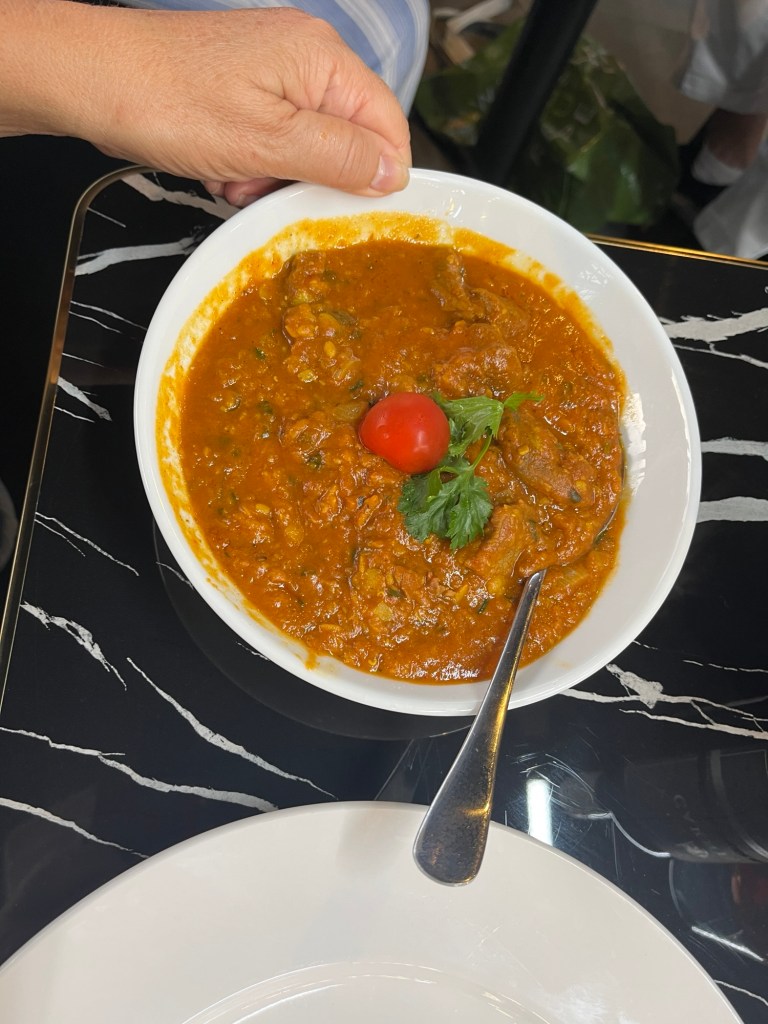
My Chicken Kadai was immediately disappointing. It had very little flavour and wasn’t particularly spicy (hot). The first few mouthful’s which I though were chunks of chicken were in fact large slices (Chunks) of Onion.
Kadai
Strangely I seemed to have two different types of Chicken.
Initially I tried to slice a lump of chicken with the side of my fork but it was too tough (perhaps firm would be a better word). So I had to cut it with a knife. Other pieces of chicken were far more tender and broke easily using my fork?
The sauce was bland and if I’m honest I didn’t rate this option at all.
The rice though was good, soft and fluffy, but it was just rice.
We all took to sharing our dishes with each other so we could get a better picture of the overall quality of the food.
Vindaloo
Jaki’s Vindaloo was, in my opinion the best as it was the only one that had any punch. Steves Dansak was really buttery and although it didn’t taste like any Dansak I had tried before, it was a very nice meal in its own right.
Dansak
Kathy’s ‘Dal’ was very good but again, it was ‘Spicy Dal’ rather than a Curry.
Dal
I like Dal as an accompaniment (though my mate Raf makes some very interesting food using Dal).
Steve and Kathy had enough left to warrant a doggy bag.
Jaki ate all her Chicken but left plenty of sauce and enough rice to make Chinese wedding cake. ( My Dad always called Rice Pudding ‘Chinese Wedding Cake’).
We decided not to have a pudding or Coffee. Our bus was due in a matter of minutes and we wanted to get back to Steve’s to watch the second half of Bristol City playing Derby on TV. So we paid up, gave a decent tip as the staff were great and headed for the bus stop.
My overall verdict on the curry was ‘moderately positive’ but I certainly wouldn’t drive past the Frampton Balti to get to the Royal.
It was more expensive and the lay-out of the venue left some thing to be desired.
I do hope they make a success of this venture and that they can build on the current business model, but they will have to work hard.
There is a Wetherspoons just around the corner where you can order a much cheaper Curry for those that aren’t precious about it being authentic, so competition will be tough.
Is butter bad for your health, or can it cut your cholesterol and diabetes risk? We speak to the experts to find out the facts.
Whether you spread it on crumpets, crusty bread or new potatoes, most things taste better with butter.
But until recently, our enjoyment was tinged with a bitter aftertaste – guilt. After all, it’s loaded with saturated fat that’s not only bad for your waistline, but a disaster for heart health, right?
However, butter is flavour of the month again.
Health influencers on Instagram and TikTok have been adding it to their flat whites and eating sticks of butter as a snack, claiming it increases energy and improves skin. While it’s easy to laugh off social media crazes, a new scientific study seemed to back them up.
What does the new research on butter say?
In June, scientists at Boston University found that eating 5g of butter a day reduced the risk of Type 2 diabetes by almost a third, and increased levels of good cholesterol (HDL) compared to margarine
They even found that margarine raised the risk of diabetes by 40% and the risk of heart problems by 30%. (It is worth noting, though, that margarine may only have fared worse than butter because the study ran from the 1970s until 2014, a time when margarines were loaded with trans fats, which are even worse for heart health than saturated fat.)
However within weeks, a report was published by nutritional scientists at Harvard University that threw shade on butter again
Researchers tracked the health of 221,054 people from 1990 to 2023, looking at associations between butter, plant-based oils and total mortality.
The results were stark.
The highest butter intake was associated with a 15% higher risk of death compared to the lowest intake.
In contrast, the highest intake of plant oils (rapeseed, olive oil and soybean) had a 16% lower risk of death, and every 10g daily increase in plant oils was associated with an 11% lower risk of death from cancer, and a 6% lower risk of death from cardiovascular disease.
So where does this leave us?
“Conflicting headlines about butter can be confusing,” says Tracy Parker, nutrition lead at the British Heart Foundation(BHF).
“However, over the last year the evidence behind butter and heart health hasn’t really changed. The evidence around saturated fats increasing blood cholesterol levels is strong. We know that over 50% of butter is saturated fat, with a teaspoon containing 5g of saturated fat, quite a large proportion of the recommended daily amount of 20g for women and 30g for men.”
Most studies around nutrition are an imperfect science, explains Parker, which accounts for the conflicting outcomes.
“They are usually observational, tracking self-reported habits over decades,” she says.
“They can’t prove cause and effect, and instead only give us associations between butter and diabetes or cardiovascular disease (CVD).”
The BHF base their advice on a wide-ranging 2019 Government report on dietary fats, which reviewed 47 previous scientific studies on the subject.
“Their message – and ours – is that high blood cholesterol levels increase CVD, and replacing saturated fat with unsaturated fat lowers blood cholesterol,” says Parker.
In essence, she says: “If you have heart disease and an unhealthy diet generally, then replacing butter with margarine is an easy win.”
Avoiding extremes is key
The flip-flopping of messaging around butter can result in extremes of behaviour, says Elena Rolt, registered nutritionist at health.miro.
“In the 1960s, the US government told people not to eat butter after the publication of the first scientific study which found a link between saturated fat and heart disease,” she explains.
“There was huge fear around butter for the next 30 to 40 years, prompting people to swap to margarine and low-fat products. Over the last couple of years, the narrative has switched to ‘let’s have lots of butter and coconut oil and avoid evil, inflammatory seed oils.’ The truth is somewhere in between.”
What about the argument that butter is a natural food?
In addition to the dialogue around processed seed oils, there is concern around ultra-processed food (UPF) and its detrimental effect on health – another reason why butter is gaining popularity in some quarters.
“There is this growing movement stating that if anything is natural, eg butter, it’s good for us, and if anything is processed, eg margarine, it’s bad for us – this is gaining momentum on the back of fearmongering around UPFs,” says Professor Sarah Berry of King’s College London, and chief scientist at ZOE.
“Yes, we have a huge problem with consuming too many heavily processed unhealthy foods, but the margarines that are now commercially available in the shops are good for us. They contain healthy blends of seed oils which we know can lower cholesterol and improve blood vessel function.
“Lard is a supposedly natural fat, but everyone knows it’s bad for us. The evidence is consistent that butter is not good for heart health because of high saturated fat.”
Butter does contain vitamins and minerals
While there is no arguing with the high saturated fat content of butter, it does have some redeeming qualities.
“Butter contains calcium, and vitamins A, D and E,” says registered nutritionist Alison Bladh.
“Butter made from grass-fed cow’s milk is also high in vitamin K, which, like vitamin D, is essential for bone health. Having these fat-soluble vitamins alongside each other in a matrix containing fat makes them easier for the body to absorb.”
However, this isn’t enough of a reason to eat butter in any volume, says Prof Berry. “If you want to have butter because it tastes good, then a small amount each day is okay. But don’t have it because you believe you are being healthy.
“I choose to have butter on toast because I prefer the taste to spreads. I counter it by using rapeseed oil for cooking, which contains polyunsaturated fat that lowers cholesterol.”
Parker agrees: “If you are not at risk of CVD ( Cardio vascular Disease)and are generally healthy, lightly buttering your toast every morning is unlikely to be a problem.”
What’s the best alternative to butter?
Margarine may not be the tastiest option, but a drizzle of extra-virgin olive oil on your bread, vegetables or jacket potato is delicious and super-healthy.
“There is consistent evidence to show it’s a really healthy oil, rich in monounsaturated fats and polyphenols that act on anti-inflammatory pathways so are really good for heart health,” says Prof Berry.
A study by scientists at the University of Cambridge found that levels of LDL ( bad cholesterol) cholesterol significantly increased when subjects ate 50g daily of butter over four weeks compared to those who had the same amount of extra-virgin olive oil.
How healthy are other full-fat dairy products?
Cheese lovers rejoice. A study in 2021 led by researchers at the University of Cambridge found that links between bad cholesterol and saturated fat are dependent on food source
The scientists found that saturated fats from cheese and yogurt lowered the risk of heart disease, while saturated fats from butter and red meat increased the risk.
How strange is this?
“We know that if the dairy is fermented, such as yogurt and cheese, the fermentation process changes the matrix of the structure such that it doesn’t have the same negative impact on cholesterol,” explains Prof Berry.
What are the best and worst fats for your health?
We’ve ranked some of the most popular fats from best to worst. Find out which to avoid, and see answers to common questions about cooking oils.
Fat is an essential part of a healthy balanced diet and provides several health benefits. It’s also a source of essential fatty acids, which the body cannot produce on its own. Fat helps the body absorb fat-soluble vitamins such as vitamin A, vitamin D, and vitamin E.
But too much fat can be harmful to our health. Some fats are proven to support our health, whilst others may damage it if eaten regularly – so it’s important to choose fats wisely. Here’s the list ordered from best to worst:
Olive Oil
Olive oil contains more monounsaturated fat than any other edible plant oil. This type of fat can help lower LDL (“bad”) cholesterol and raise HDL (“good”) cholesterol.
Kirsten Jackson, consultant IBS dietitian, says olive oil is a heart-healthy choice. She tells Saga Magazine: “There is a myth that when you heat olive oil it turns into a type of fat known as trans fats which are bad for our health, but this is incorrect. Trans fats are only produced in a commercial environment [not through cooking at home].”
Tracy Parker, Nutrition Lead at the British Heart Foundation, tells us: “Unsaturated oils, like olive oil, sunflower oil and rapeseed oil, contain healthy fats that can help lower bad cholesterol and reduce the risk of heart disease.
“Extra virgin olive oil is the least processed type of olive oil and contains more antioxidants, which are linked to better gut and heart health.
“That is not to say you cannot use other types of plant oils as well, as they all have different tastes and may work better in different dishes.”
Research suggests that olive oil may lower the risk of heart disease and stroke due to its anti-inflammatory properties. It is often associated with good heart health, particularly because of its role in the
In the UK, vegetable oil is usually rapeseed oil. It is extracted from the seeds of a plant in the cabbage and mustard family, with bright yellow flowers that bloom in the spring.
Tracy Parker explains that rapeseed oil is a relatively good option because it is low in saturated fat – containing the lowest amount of any oil, with just half the saturated fat found in olive oil. Research has shown the risks of a high saturated fat diet.
“Similar to olive oil, it is high in monounsaturated fat. Cold-pressed rapeseed oil is a great choice for everyday cooking. It has sometimes had a bad reputation, especially in the USA, where it is known as canola oil and was historically used in industry. However, oils in the UK undergo strict controls to ensure safety,” Tracy adds.
So, avoid American oil?
Nutritional content (per 100ml):
Energy: 823kcal
Total fat: 91.4g
Saturated fat: 13.1g
Monounsaturated fat: 79.4g
Polyunsaturated fat: 7.5g
Salt: 0g
3: Avocado oil
Image credit: GettyImages/TanyaLovus
A newer, trendy oil for cooking or salads, avocado oil has similar benefits to olive oil.
“It is almost identical to olive oil in terms of its fatty acid profile – both are high in monounsaturated fats. However, avocado oil tends to be more expensive because it’s considered a niche oil and is less widely produced,” says Tracy Parker.
She recommends using avocado oil wisely if you are going to use it. “For everyday cooking, a more affordable healthy oil is fine. Save expensive oils with strong flavours for salads, dips, or marinades.”
Bear in mind that whole avocados will have more health benefits than the oil, as they contain more fibre, vitamins and minerals. For example, you could have avocado on toast, rather than bread dipped in avocado oil.
Nutritional content (per 100ml):
Energy: 809kcal
Total fat: 91.4g
Saturated fat: 16.9g
Monounsaturated fat: 60.6g
Polyunsaturated fat: 9.9g
Salt: 0g
I have found this relatively cheap in COSTCO.
4: Rice bran oil
Extracted from the outer layer of rice, rice bran oil is low in saturated fat and high in monounsaturated fat. It’s popular as a cooking oil for some Asian foods. It has a high smoke point, so is suitable for cooking at high temperatures, and a mild flavour.
Tracy says: “Similar to avocado, olive and rapeseed oil, it’s low in saturated fat and high in monounsaturated fat and is considered a healthy oil to cook with.”
Nutritional content (per 100ml):
Energy: 813kcal
Total fat: 92g
Saturated fat: 21g
Monounsaturated fat: 39g
Polyunsaturated fat: 32g
Salt: 0g
5. Sunflower oil.
Sunflower oil is a popular choice for high-heat cooking, as it has a high smoke point. It’s naturally high in polyunsaturated fats, although you can also get high-oleic sunflower oil, which means it’s made from sunflowers which have been bred to be higher in monounsaturated fat.
Does this include GM modification I wonder?
“All oils, including sunflower oil, should be used in moderation – they are all high in calories, around 100kcal per tablespoon. There is also no need to worry about cooking with oils as home cooking temperatures aren’t high enough to spoil the oil.
Just make sure not to reuse the oil after cooking,” says Tracy.
Nutritional content (per 100ml):
Energy: 828kcal
Total fat: 92g
Saturated fat: 10.1g
Monounsaturated fat: 26g
Polyunsaturated fat: 56.1g
Salt: 0g
6: Palm oil
Palm oil contains around 50% saturated fat, similar to butter.
Kirsten says: “Many manufacturers opt for using palm oil because their product needs to contain a fat that is solid at room temperature and this is not possible with other oils like olive oil.
“Overall, I wouldn’t recommend that people are cooking with palm oil as it is not as beneficial for health as olive oil, but having the occasional product that contains this type of fat is unlikely to have a negative impact when you are having a balanced diet otherwise.”
Tracy adds: “Palm oil is cheap and often found in many processed foods like snacks and baked goods, so you might be eating more of it than you realise.
“Processed foods also tend to have high levels of unhealthy fats and sugars, which we should eat less of. Limiting these foods can help reduce your intake of palm oil.”
Nutritional content (per 100g):
Energy: 884kcal
Total fat: 100g
Saturated fat: 49g
Monounsaturated fat: 40g
Polyunsaturated fat: 9g
Salt: 0g
7. BUTTER
Butter is mostly made up of saturated fat, the type which can raise cholesterol. Although it’s not the worst on our list, it’s not an ideal choice.
Tracy says: “Especially if you have high cholesterol, the simple swap from butter to using an unsaturated oil or margarine would be better for your health. If you’re otherwise healthy, a bit of butter on your toast is not going to make a big difference. If you use a lot of butter in your diet, then it’s wise to make a change to using an unsaturated fat such as olive oil, rapeseed or sunflower oil or spread.”
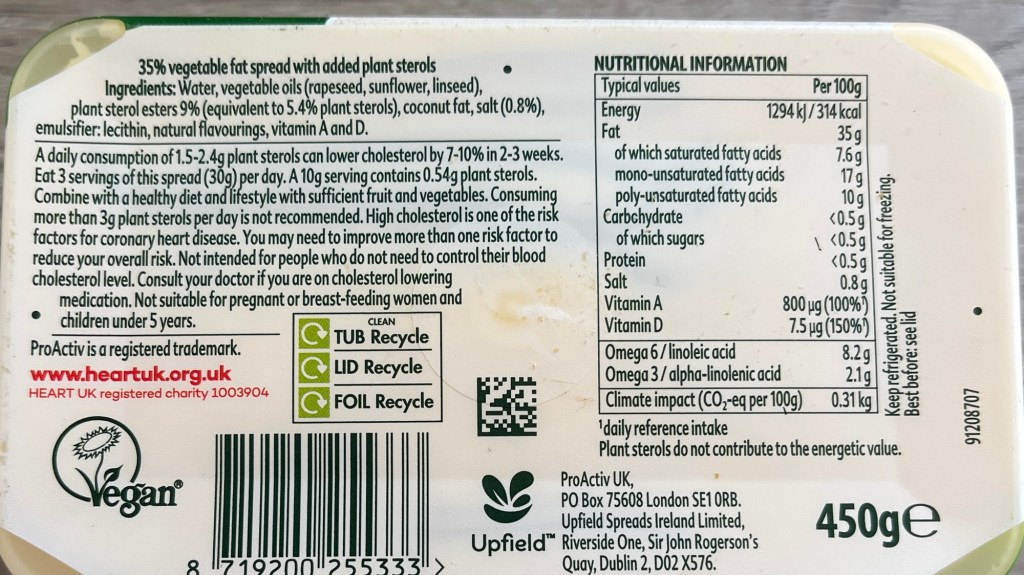
Spreadable butter is marginally healthier, because it usually has vegetable oil added, but an unsaturated spread would be a better option for your heart.
Nutritional content (per 100g of slightly salted butter):
Energy: 739kcal
Total fat: 82g
Saturated fat: 52g
Monounsaturated fat: 21g
Polyunsaturated fat: 3g
Salt: 1.2g
8: Coconut oil
Despite its reputation as a “healthy” fat, coconut oil is approximately 85% saturated fat.
Tracy says: “It contains more saturated fat than butter, so excessive intake should be avoided by those with high cholesterol.
“If you like the taste, it is fine to use every now and then, but use unsaturated oils as an everyday choice.”
Nutritional content (per 100ml):
Energy: 767kcal
Total fat: 92.5g
Saturated fat: 86.6g
Monounsaturated fat: 6.3g
Polyunsaturated fat: 1.7g
Salt: 0g
Bad for you.
All of these are solid white fats obtained by rendering fatty tissue from animals. Lard is usually from pigs. Dripping, tallow and suet are usually from beef, though they can be from mutton or lamb. Suet is the fat from around an animal’s kidneys. Tallow is technically the fat from around the organs, although in the US the term tallow is used interchangeably to describe dripping or suet.
These fats are higher in total fat content than butter.
Tracy explains: “Like butter, these are hard animal fats high in saturated fat, which can increase cholesterol levels. It is best to use sparingly.”
Although some people claim that lard is good for you, because of the mix of fats it contains, there’s very little evidence to show it has heath benefits in humans, whereas there is some evidence linking it to worse health outcomes.
Nutritional content (per 100g of lard):
Energy 898 kcal
Total fat 100g
Saturated fat 44g
Monounsaturated fat 41g
Polyunsaturated fat 11g
Salt 0g
Nutritional content (per 100g of beef dripping):
Energy 900kcal
Total fat 100g
Saturated fat 57g
Monunsaturated fat 36g
Polyunsaturated fat 3g
Salt 0g
Are seed oils bad for you?
Seed oils are oils extracted from seeds. In the UK, the most common are rapeseed (known in the US as canola oil, it’s often sold as vegetable oil in the UK) and sunflower oil. You will also find soybean, corn, grapeseed, rice bran and safflower in many products.
Seed oils have recently had a bad reputation among some celebrities, particularly in the United States, because of their omega-6 content and supposed link to inflammation.
But there’s no solid evidence to support this, says Tracy.
The American Heart Association also agrees that there’s no need to worry.
Tracy says: “Seed oils often get a bad reputation because of their omega-6 content and supposed link to inflammation, but there’s no solid evidence to support this.
“Omega-6 and omega-3 are both essential fatty acids, meaning we need to get them from our diet. Both types of fats are good for heart health, and it’s important to have a balance between them.
“Most seed oils contain a mix of both omega-6 and omega-3 fats. Like all oils, they should be used in moderation.”
Another concern of seed-oil sceptics is how the oil is produced. More processed forms of oil may use chemicals such as hexane to extract the oil, but these chemicals are removed in the finished product.
The processing can also help to remove substances that can make the oil go rancid or cause it to smoke at high temperatures.
Are all unsaturated oils the same?
Variety is the spice of life when it comes to unsaturated oils.
Tracy says: “All unsaturated oils are good for you, but they contain different types of healthy fats. Some oils, like olive, rapeseed, and avocado oil, have more monounsaturated fats. Others, like sunflower, corn, and walnut oil, have more polyunsaturated fats.
“Each type offers slightly different health benefits, so it’s good to include a variety in your diet.”
Are more expensive cold-pressed oils better for you?
Cold-pressed oils can contain higher levels of antioxidants, and won’t contain any traces of the chemicals that are sometimes used in industrial processing of oils. ( I thought this article suggested these were completely removed)?
But they are a more expensive choice, and any unsaturated oil, such as inexpensive sunflower or vegetable oil, is likely to be a more heart-healthy option than butter or palm oil.
Kirsten says: “Cold-pressed oils are processed without heat, and heat can break down some of the nutrients in foods so a cold-pressed oil is higher in many beneficial components, such as oleic acid which is a type of monounsaturated fat that reduces levels of bad cholesterol and increases levels of good cholesterol. It also acts as an antioxidant.”
So in summary despite all the evidence on line, provided by Professors, nutritionists, Doctors and cardiologist ( I keep the information in my saved files) it seems the British Heart foundation don’t agree.
Butter in anything other than small portions is bad for your heart because it increases Cholesterol.
Processing oils doesn’t apparently cause a problem.
Rape seed oils are apparently better for your health that Butter or Coconut Oil, despite the hype.
It seems the establishment aren’t prepared to change their recommendation’s so if we accept they know what they are talking about, we have to listen to their advice.
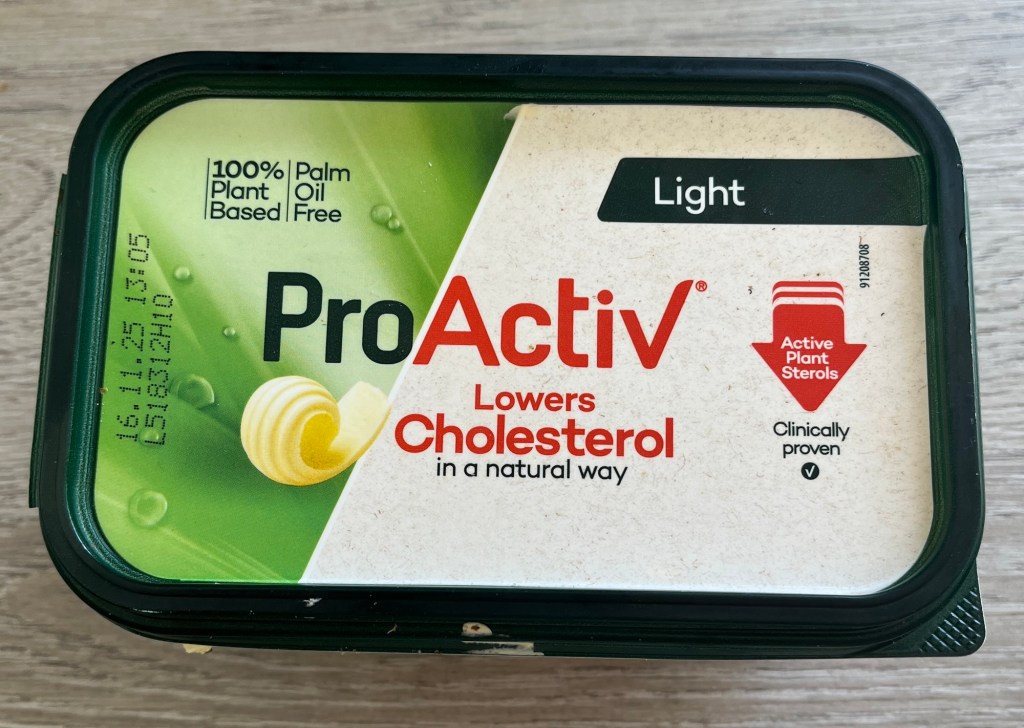
For now at least I will stick with my spreadable Margarine (even though it is processed ) plus extra virgin olive oil and only use other fats like Coconut oil occasionally.
Pity, I thought for a minute life had gotten better.
I saw on a local face book page that Gurt Wings were running a Pop up in Yate on Thursday 14th August so I decided to give it a try,
Now I’ve seen Gurt Wings on Instagram and the Influencer was raving about it, but as he was eating free food and I suspect he was being paid, I would be surprised if he complained.
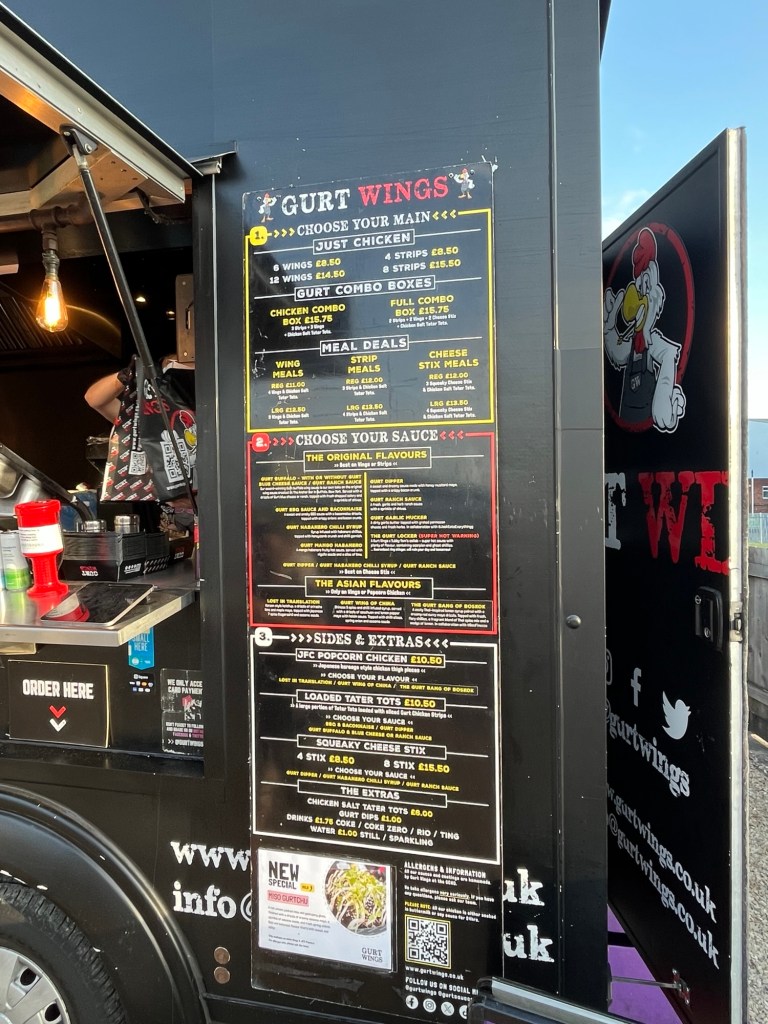
Having not tried Gurt Wings it was a bit of a punt. I didn’t really know what was on offer and when I saw their menuI knew I was in a strange new world.
Now my experience of Wings was honed at Hooters in The USA where the sauce was hot and the waiting staff, even hotter.
My friend Steve, who lived in Cape Coral, Florida, used to send me Hooters Sauce through the post so we could make our own wings. But wings aren’t a great meal, there is lots of skin, lots of bone and the constant fear that the chicken is under cooked.
My mate Pete came for Dinner last Sunday night and we did Ribs and spatchcock chicken, which was delicious. But Pete cannot eat meat off the bone. So if he can’t cut it off with a knife and fork, he can’t eat it.
So Wings wouldn’t be for him.
When I found the van there was a small crowd and I heard one of the staff say he expected it to be quiet so I was glad to see there were some people there.
It took me some time to study the menu which at first glance looked a bit overwhelming.
It was similar to Nando’s where you chose your main, then your sauce, then the extras.
Not knowing anything about their menu I really didn’t know where to begin. The more I read the more confused I became. I got snow blind and couldn’t really make sense of what I was reading.
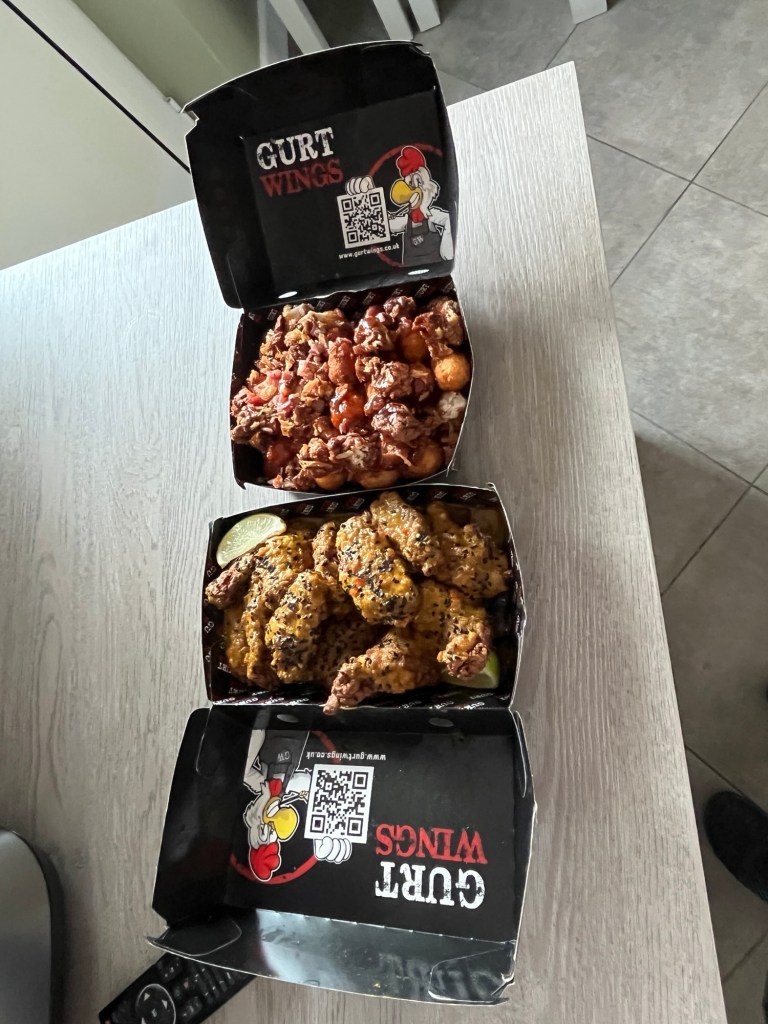
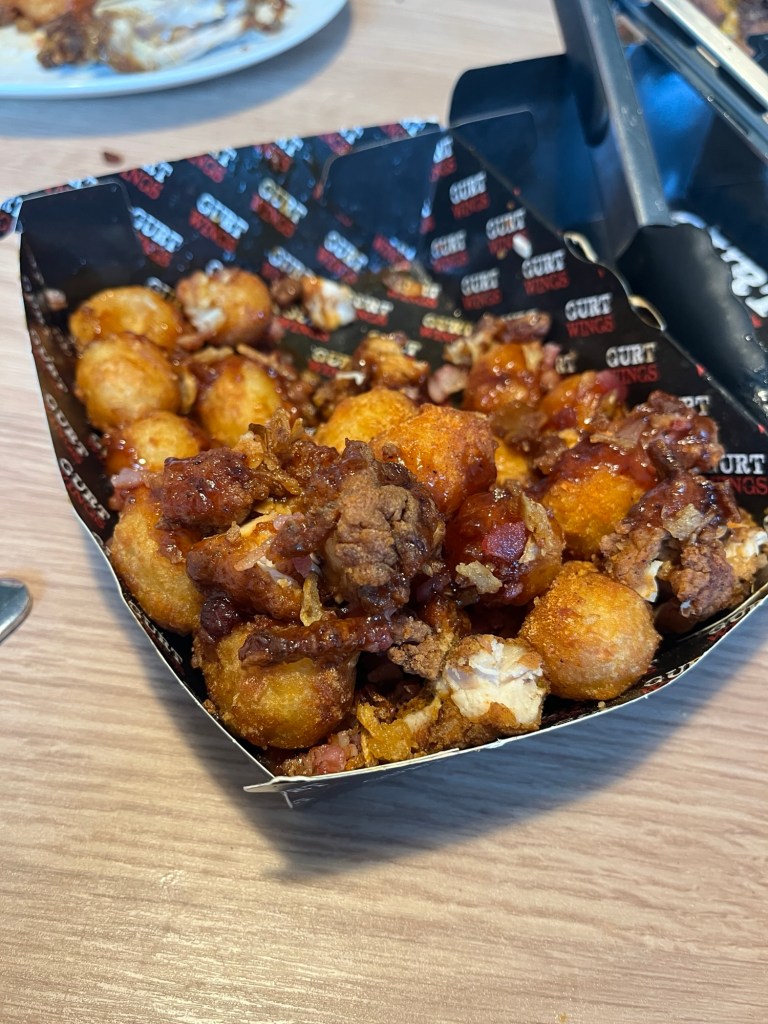
In the end I just took a chance and ordered a box of 12 wings (£14:50) with Gurt Mango and Habanero sauce, plus loaded Tatter Tots.(£10:50).
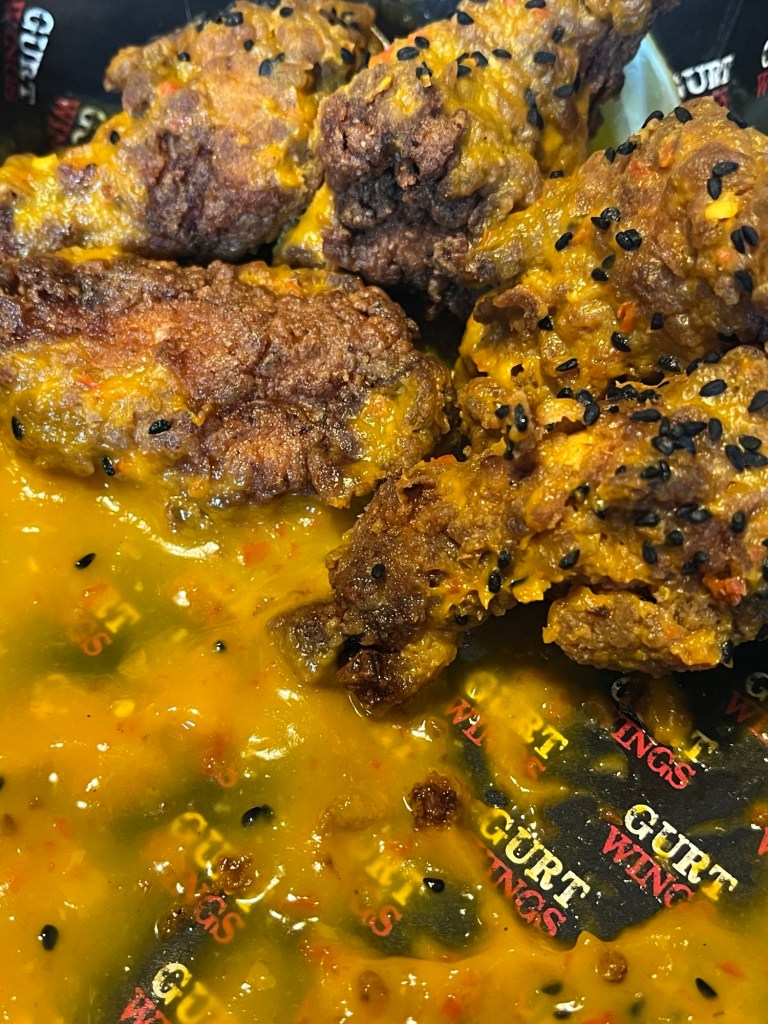
The wings were good quality with plenty of meat but they have some sort of coating ( like a batter but it was hard to see when they were covered in sauce).
The sauce was spicy enough but I found the mango far too sweet. Once the sauce mixed with the wing coating it made a soggy gloop which I really didn’t like, though Jaki thoroughly enjoyed hers.
I wish I had tried the original sauce or maybe just had the wings without any sauce, though my preferred option would be to have the sauce in a separate container so you can dip the wings, rather than have them floating in a soup.
The Potatoes didn’t do it for me either. I would have preferred some decent fries rather than these little potato balls.
So, in summary I wasn’t very impressed but I think I made some bad choices and i should have done some home work before ordering.
When it came to paying I used a card but the sun was reflecting off the screen so I couldn’t see what was on the screen. Let’s hope I got charged the correct amount?
I hope this venture takes off and people support them as it adds yet another option to our eating experience but know what the choices are before ordering.
Shaftesbury Park Frenchay Bristol South Gloucestershire BS16 1LG
Tel: 0117 957 5585
Well this was a new one and a very welcomed addition to our repertoire of venues.
Dot was in the big chair so this was his choice and what a good one it was.
I have often seen this site from the M32 as I’ve been traveling into Bristol, but its the first time I’ve actually been in the ground, which isn’t surprising as I’m not really a big Rugby fan.
I used to work with a guy (Dave Appleton) who played for Dings when they were based in Lockleaze but they sold their ground and managed to develop a very professional club site in French some years ago.
I did spot his name on the trophy wall back in 1983.
The venue is very modern and it smelt more like a dentist surgery than a Cafe as we went up the stairs from the front entrance.
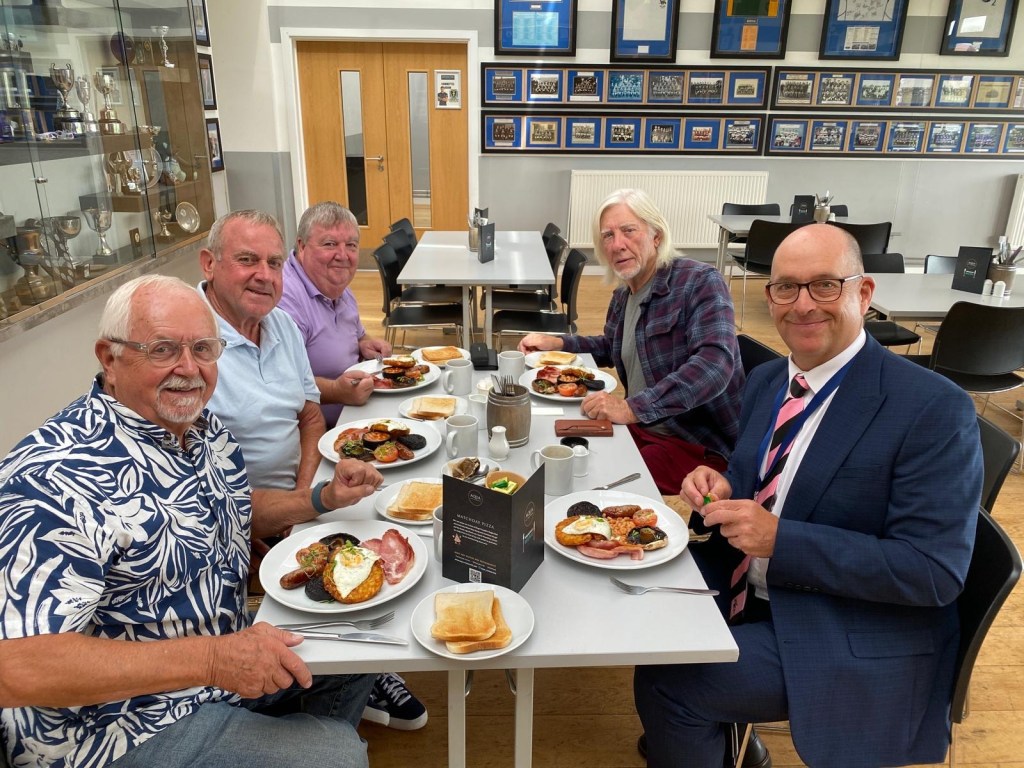
Pete was already in there talking to the staff when we arrived. He was suited and Booted as he was working today driving for Avon and Somerset Police, so he had to ensure he didn’t spill any sauce down his clean white shirt.
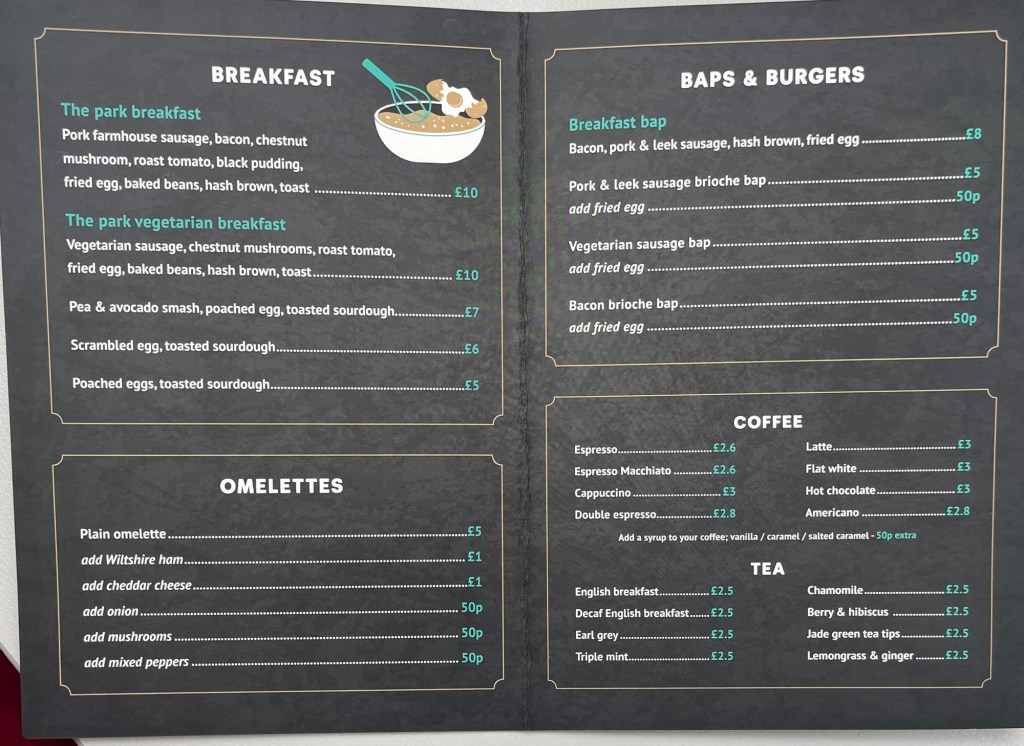
The Menu was very straight forward but it had enough options to keep most people happy.
We all went for the Park Breakfast:
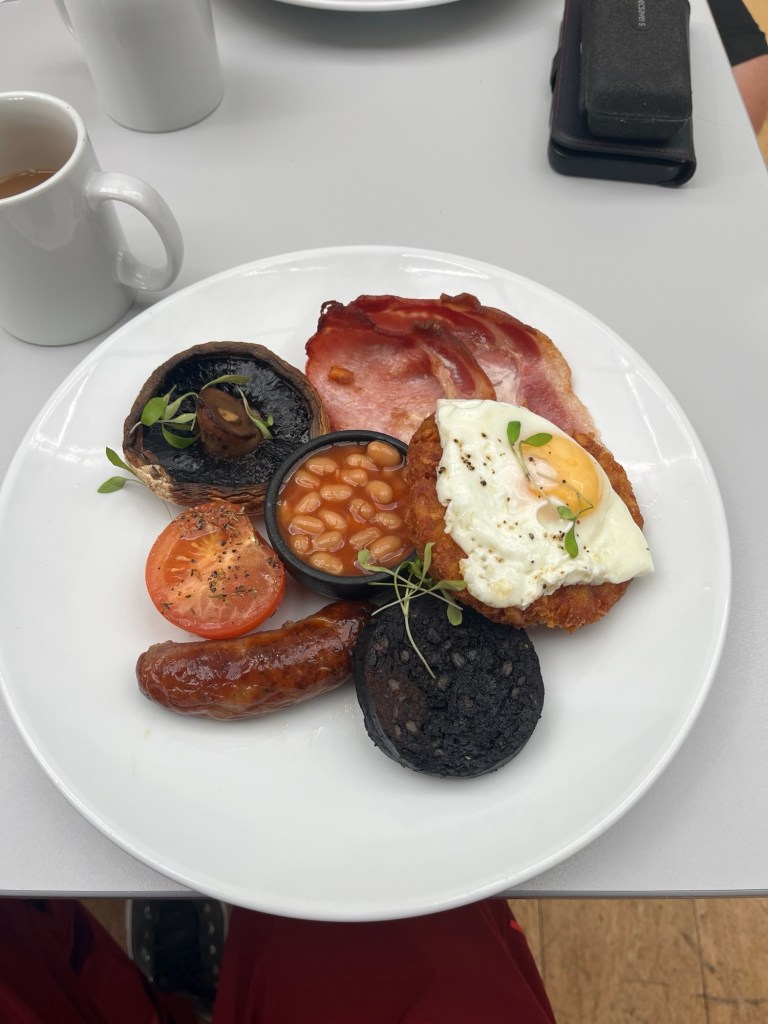
Pork farmhouse sausage, Bacon, Chestnut Mushroom, Roast Tomato, Black Pudding, Fried Egg Baked Beans and Hash Brown with Toast on the side £10.
So let’s dissect this offering.
There was only one sausage which was a shame as it was very tasty. Two slices of bacon that were a bit dry but tasty enough. The large Mushroom was firm and tasty but the Tomato was a bit inchoate and could have done with being tortured over the coals a bit longer.
The slice of Black pudding was generous but like most venues, they seem frightened to cook it and I like mine with a crispy edge.
The fried egg was fine as was the small dish of Baked beans but the star of this show was the Hash Brown which was cooked beautifully and had sweet corn in it. If this wasn’t home made then I want to know where these were bought because they were excellent.
The white toast (no choices) was served on a side plate like a Pyx, it was wonderful to be able to spread the butter without having to lay the toast on the table top.
Service was exceptionally good (though there was only one other table in service so they weren’t rushed off their feet. Pity really as this was a big open venue and a few more customers would have created a better atmosphere and I’m sure, pleased the staff).
Food came hot and nicely plated.
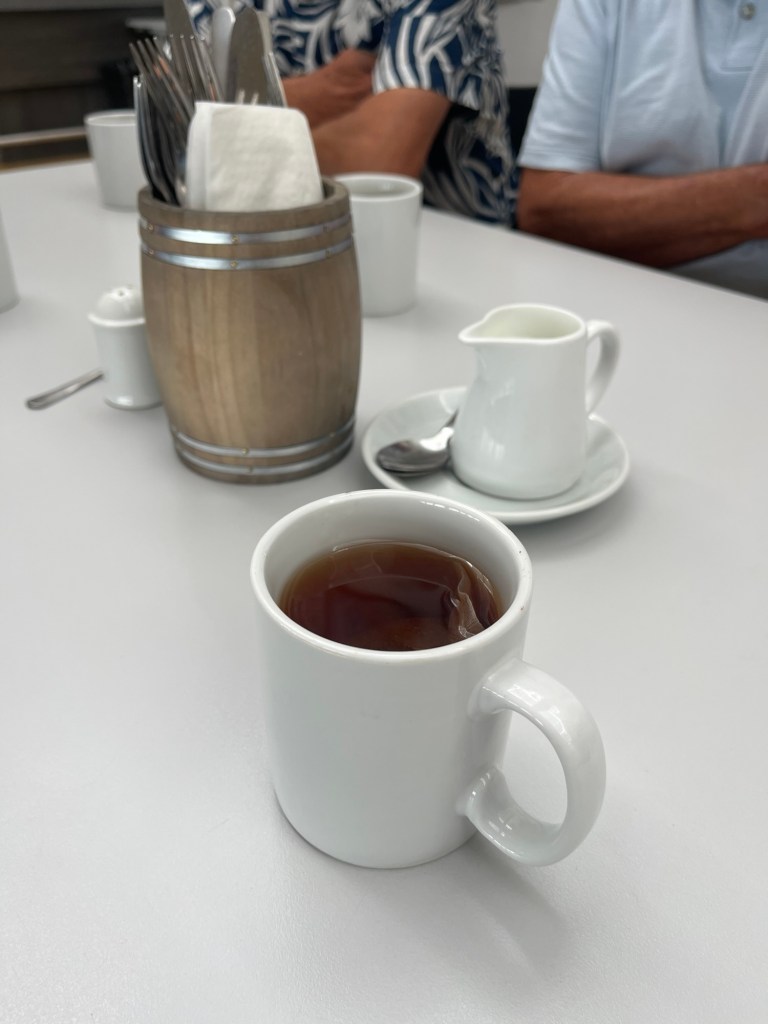
Tea was served in mugs with the T Bag still in, but luckily there was a saucer provided for the bags once they had served their purpose. It was hot and tasty though there was no sugar on the table and we had to ask the server to bring some. Sauces were in the original bottles and again, were delivered to the table on request.
Being in a Rugby club with 4 blokes who love Rugby it was unsurprising that ‘Rugby’ dominated the conversation and a large flat screen TV above the table only served to add to the theme by constantly showing rugby Highlights and interviews.
When we eventually made our way out to the spacious car park we noticed a signs advertising Sunday lunches and we all agreed it would be worth giving it a try.
This was definitely one of the better breakfasts and at £10 it wasn’t overly expensive.
They need to work on their advertising as Im not sure how many people realise this facility is available and with random opening’s it can get a bit confusing, so they need to make more people aware or they might have to cut back, which would be a shame.
Is this your new site? Log in to activate admin features and dismiss this message